Autumn 2019
Predicting EUR/USD With Hanning Windows
A weekend frequency-domain experiment that did a passable job on EUR/USD. I would not have trusted it with my money, and I didn't.
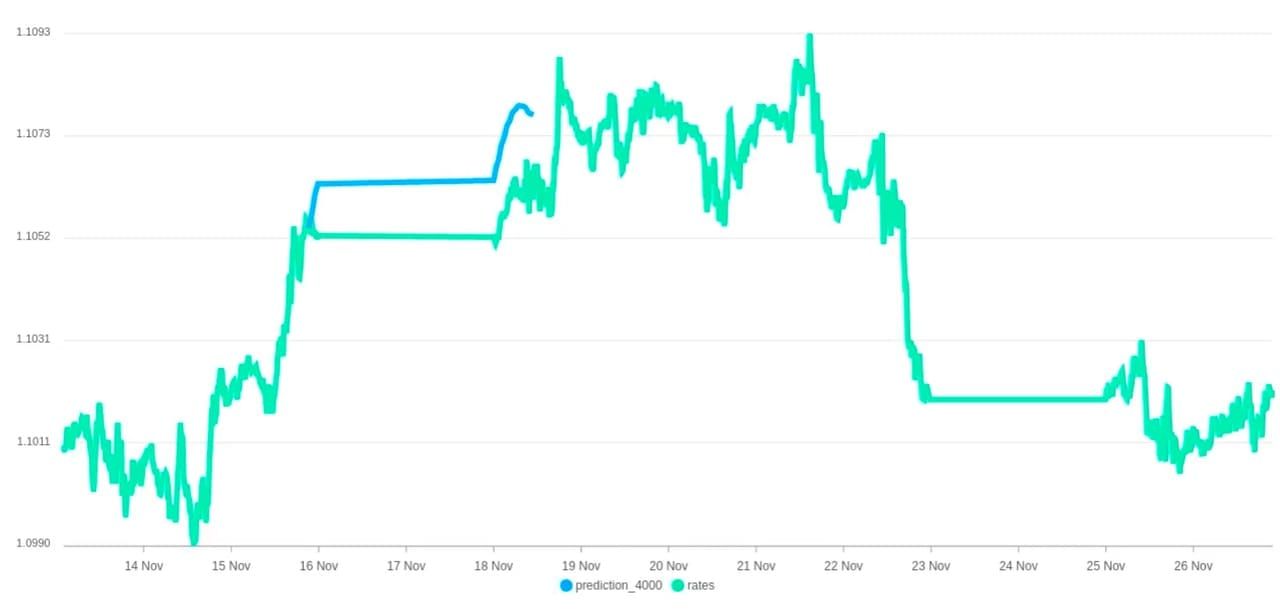
In the autumn of 2019 I was an undergrad with a few weekends free and the quiet conviction that I could find a small edge on EUR/USD. The screenshots were flattering: the prediction (blue) hugged the actual rate (green) in a way that looked like skill. A linear regression in the frequency domain, dressed up. I did not trade real money with it, and that restraint is the only thing about the project that aged well.
The pipeline:
- Smooth the input series.
- Differentiate.
- Short-time Fourier transform with overlapped, Hanning-windowed frames.
- Extrapolate the frequency-domain coefficients.
- Invert everything back to a predicted price series.
A Python server (NumPy, SciPy, Flask) ran the model. An MQL4 client on a broker terminal called the server and would have placed trades if I’d dared.
What I actually learned: even a naive model can show a sometimes-profitable backtest, and that’s the trap. The real game is built by people with co-located servers, microsecond ticks, and millions in infrastructure. This project taught me how far my edge wasn’t.
Related articles
-
An Obsidian Sync Built Around the Merger I Already Had
VaultLink: self-hosted Obsidian sync. Edit in any editor, online or off, then come back to a converged vault. The app that justified reconcile-text.

-
Backing Up Running Databases Without Stopping Them
A Bash container around BorgBackup. BTRFS snapshots give atomic consistency, numeric env vars give multi-target 3-2-1, the loop is sleep not cron.

-
25 Million UK Property Rows in a Single Rust Process
Notes on perfect-postcode.co.uk. Every numeric feature is u16-quantised in a row-major array, so filter eval is two integer compares per row.